
Step-by-Step Guide to ICF Construction & Installation

Building with ICFs is faster and more efficient than traditional wood framing. This guide covers the entire installation process, from excavation to the final pour.

Looking for block dimensions and specifications? View our BuildBlock Insulated Concrete Forms product page.

Building your new home is great, but building your new home with BuildBlock ICFs is even better.

The task of building your own home can be daunting. Luckily, BuildBlock is here to break down the different steps involved in the process. Here is a step-by-step overview of each part of the building process explaining each component with technical instructions. 

How are ICF buildings constructed?

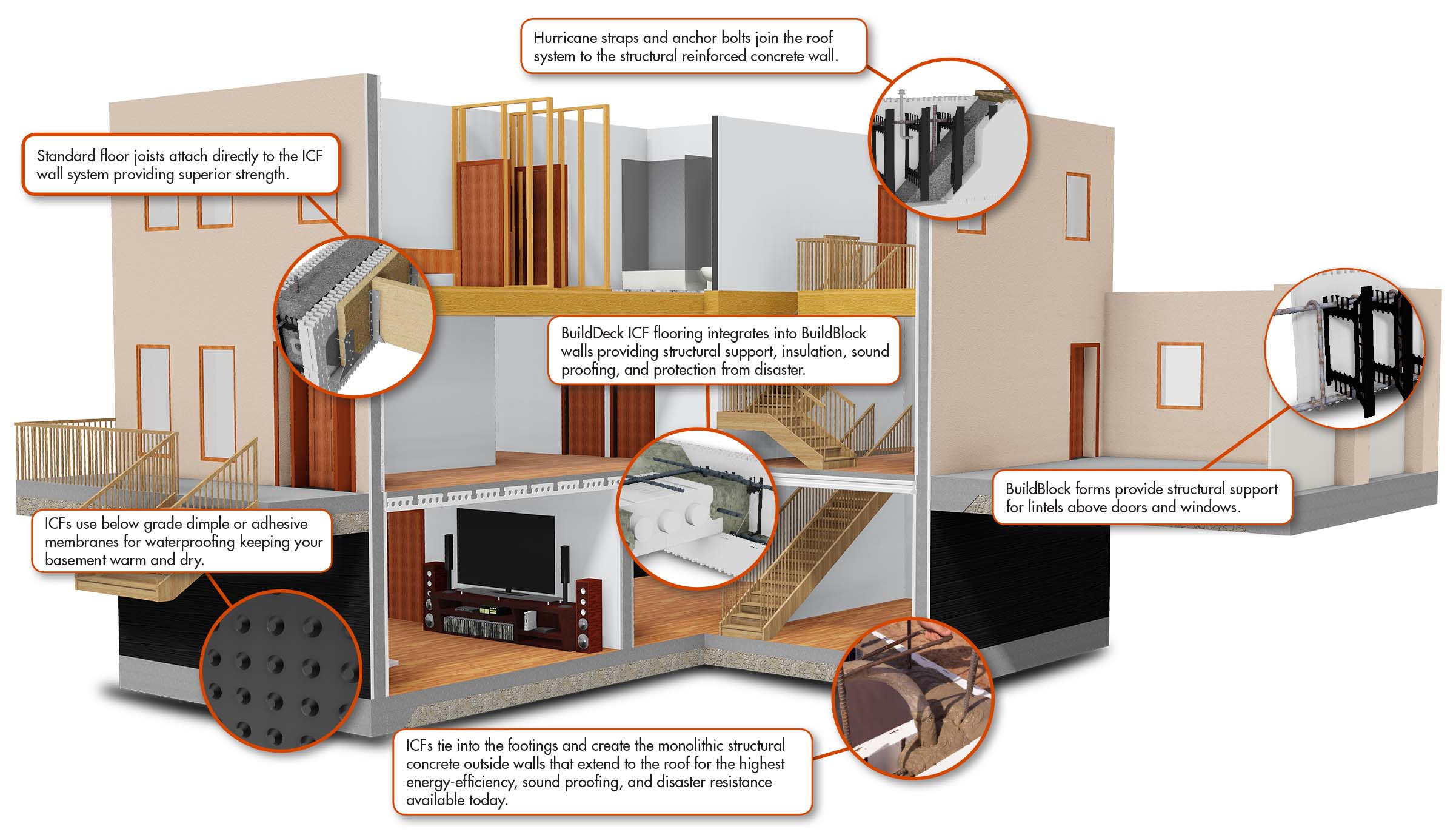
ICF buildings are constructed using a running bond interlocking manner with the most common size of 4 foot long and 16 inch high blocks. Height and length may vary in some instances depending on the manufacturer. Evenly spaced webs create a cavity that give the block its strength. The thickness or the width of the cavity can vary from 4 to 12 inches or more. The most common wall sizes are 6 and 8 inches.  Most manufacturers offer corner blocks, 45-degree blocks, brick ledge forms and taper top blocks along with various accessories and fittings. Some blocks are fully-reversible, adding to the ease of construction. ICFs allow for unlimited design flexibility. You can easily construct radius walls, multiple elevations, and other architectural features using ICFs.

First, horizontal reinforcing (Rebar) is installed as the forms are being placed. Next, when walls become too high to reach from the ground, bracing or alignment systems made specifically for ICFs are installed. These bracing systems have foot plank brackets for the placement of the planking to complete the stacking of forms. The concrete is then poured, generally, one level at a time.

Vertical steel is placed before each pour and if the structure above is a continuation of ICFs, then a cold joint dowel would be placed to tie the next pour to the first. Most bracing systems have adjusting turnbuckles which allow the walls to be perfectly straightened as the pour is finished. Also, most companies offer training and technical support in addition to providing installer manuals, pre-engineered tables, CAD details, and engineering models.

The 22-Step ICF Installation Process

Phase 1: Site Preparation & Footings

After zoning and building permit requirements are met, prepare the site for footings or slab on grade construction.

Setting batter boards and string lines for BuildBlock ICF foundation layout

Formwork is placed for footings as per local codes or as specified.
Excavating trench for ICF footings to frost line depth

A pre-pour inspection may be required, check with local code officials. Place concrete in formwork. Care should be taken when consolidating concrete to eliminate voids or honeycombing.
Completed stepped footings trench ready for ICF installation

Level footings make the whole building process easier. Take a little extra care here.
Placing horizontal and vertical steel rebar reinforcement in footing trench

Place vertical reinforcing as specified or per local codes and/or the BuildBlock Engineering Manual found at buildblock.com
Pouring and leveling concrete footings for ICF foundation

Once lines are snapped on footings, materials can be staged for faster installation.
Roughing in plumbing and electrical penetrations through concrete footing

Phase 2: Wall Stacking & Reinforcement

Starting at a corner, begin stacking wall.
Placing first course of BuildBlock ICF forms starting at corners

Place horizontal reinforcing as specified. Reverse corners each course to create a running bond layout.
Installing horizontal rebar into plastic webs of ICF blocks

If the wall requires cutting block, try to cut square and straight using the one inch repeat on the block. Placing cut block at window and door locations will simplify the build.
Stacking second course of ICF blocks with offset running bond pattern

After two or three courses have been placed, shim and trim as needed so walls are level and plumb. Spot glue to footing or slab and wait for foam adhesive to set before continuing with your wall.
Leveling first courses of ICF wall using laser level and shims

Flip corners each course to ensure the proper offset is maintained and vertical seams avoided.
Installing BuildBuck window and door bucks in ICF wall assembly

Working off of the erected alignment system makes stacking the remaining block easy.
Stacking BuildBlock ICF walls to full ceiling height

Using an approved alignment/ bracing system, such as BuildBrace 1, place as per O.S.H.A. recommendations. Windy locations may require placing the alignment system after the first or second course. Normally the 3rd or 4th course works best.
Installing BuildBrace alignment system to plumb and secure ICF walls

Window and door bucks should be made and ready to set in place as you are erecting the wall.
Sliding vertical rebar into stacked ICF wall cavity before pour

Here is an example of a window with V-Buck bucking.
Cutting out windows in ICF foam and installing buck system.

Any penetrations must be made before the concrete is poured.
Cutting utility sleeves and penetrations in ICF foam sidewalls

Place horizontal reinforcing as specified. Note: the chase created to hold the vertical reinforcing in the proper location by staggering the horizontal reinforcing.

Place vertical reinforcing making sure to align it between the staggered horizontal reinforcing.
Place vertical rebar reinforcing for ICF wall.

Phase 3: Pouring & Final Adjustment

After the wall is poured one person can use the adjustment on the top of the alignment system to ensure the wall is square and plumb.
Adjustment on the top of the alignment system to ensure the ICF wall is square and plumb.

Pouring in 4’ lifts, continue pouring until the concrete reaches the desired level. A low impact concrete vibrator with a 1” head is recommended to consolidate concrete during the pour.
Pouring concrete into ICF forms

When topping the wall leave extra concrete until all consolidation is completed. Place anchor bolts or straps when leveling the wall after consolidation. Time is of the essence, make sure you have time to finish, plumb and level wall before concrete sets.
Topping the wall - finishing the concrete at the top of the ICF wall.

Make sure top of wall is clean and flat. Wipe away debris and splatter. Once the final alignment is finished, stay off the alignment system to avoid possible movement of the wall. Sight wall after a half an hour, adjust wall as needed.
Concrete pour complete for ICF wall

Let Us Help

Contact BuildBlock today and let our staff answer your questions and help make your project a success.