How to Build a Basement Foundation Using Insulated Concrete Forms (ICF)

Here is a complete step by step process of how to build a basement foundation using insulated concrete forms (ICF), from the initial excavation through the concrete pour and final waterproofing. 

Insulated concrete form basements are constructed using ICF forms in each core size, offset with a running bond and interlocked together in a comprehensive system. The most common block size being 4 feet long and 16 inches tall with 90-degree corner blocks. Other specialty forms include tapertops for a wider bearing surface, brickledge forms that create a corbel ledge at a given height for stone or other masonry finishes, and 45-degree corners. 

The concrete core ranges from 4 to 12 inches or more in core width, with 6-inch and 8-inch walls being the most common choice for residential work. Each form has 2.5- inches of continuous expanded polystyrene (EPS) foam insulation on each side with embedded firring strips every 6-inches on center for attachments and rebar placement in the core.  

For a basement, an 8-inch core is typically preferred, as it provides the wall thickness necessary to resist soil pressure over the full depth of a below-grade wall while still accepting standard rebar patterns. Poor soils or other site considerations may require a thicker wall which is easily accommodated. 

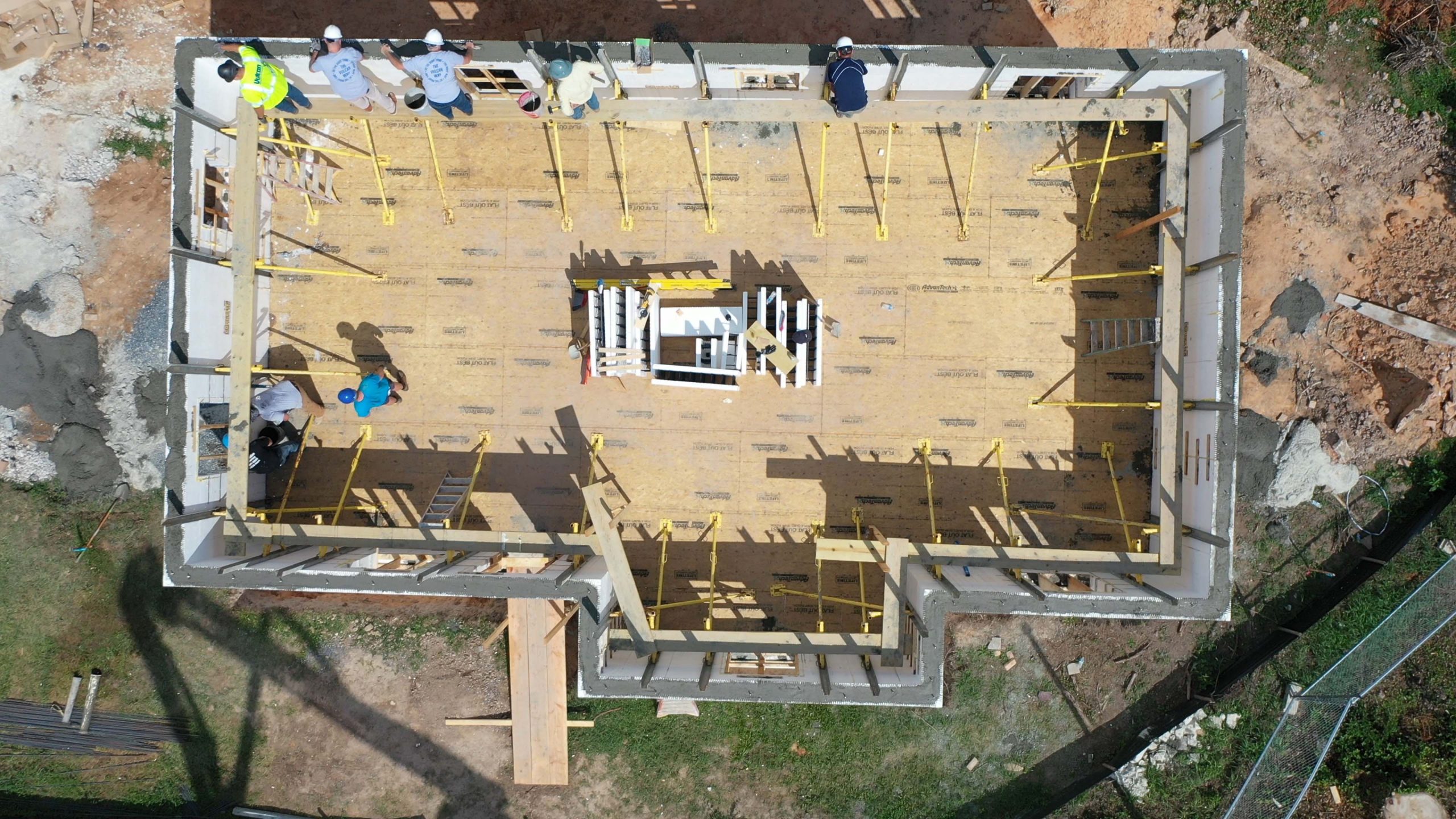
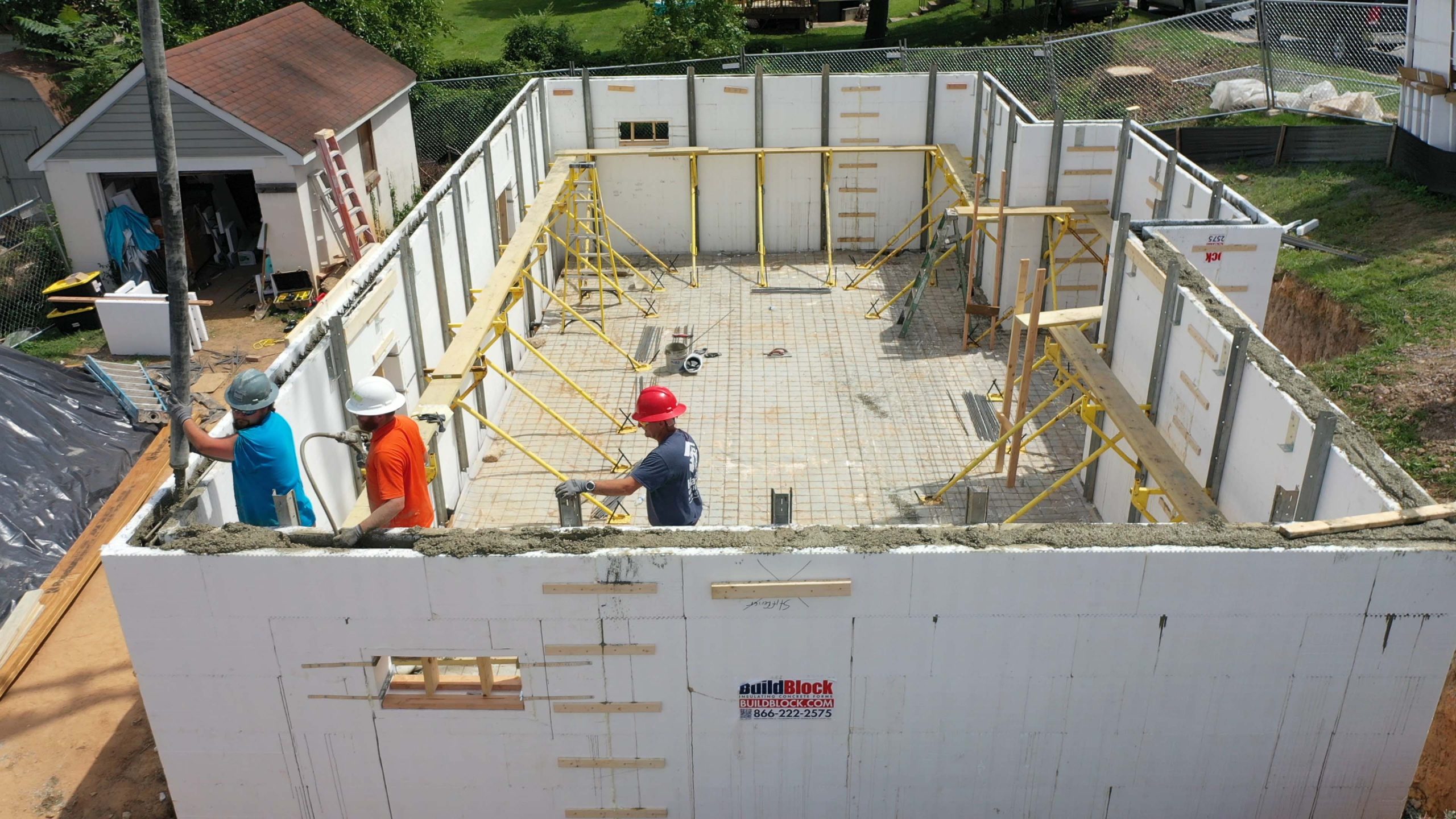
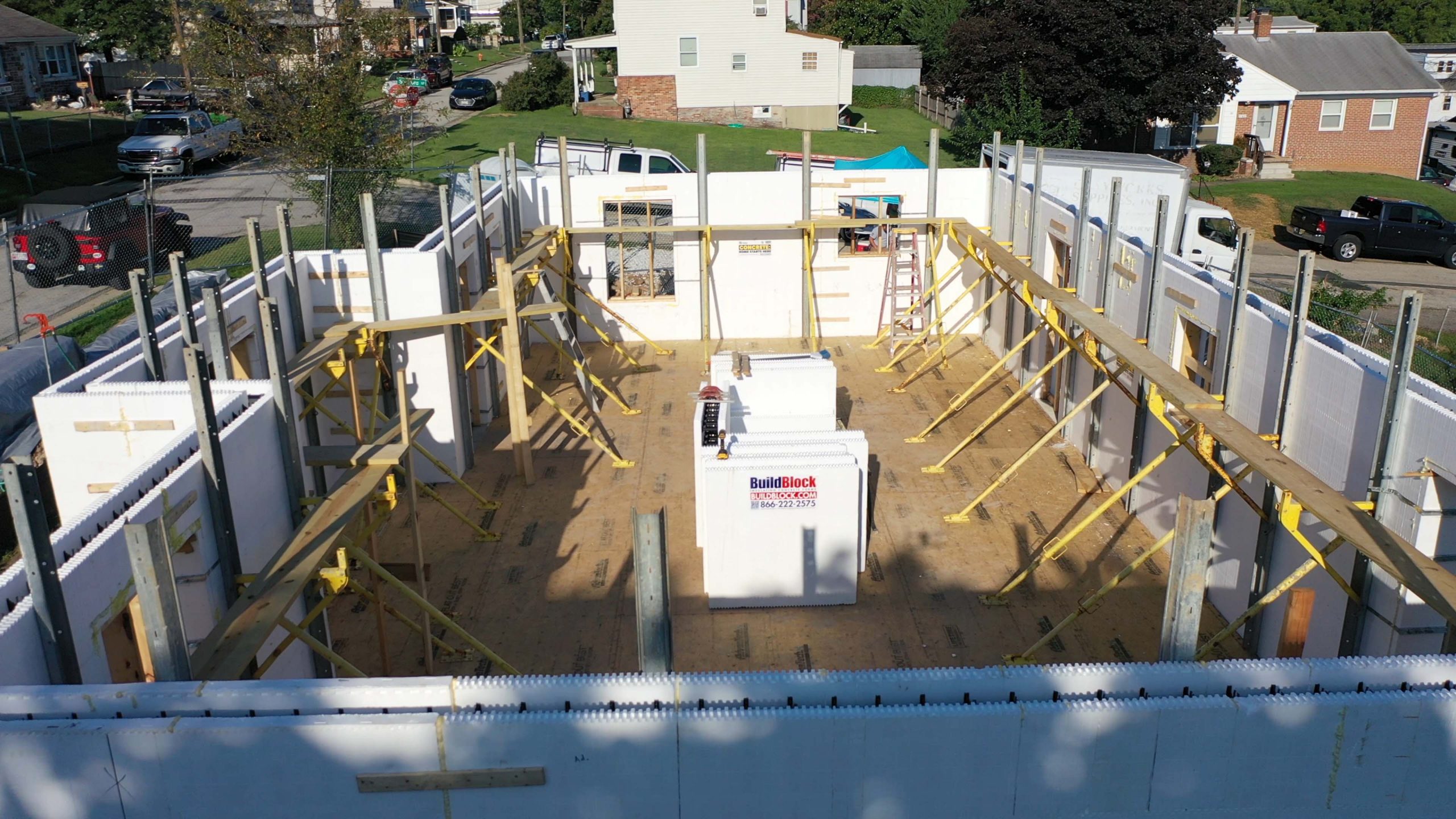
open ICF basement ready for concrete pour
ICF basement walls stacked, braced, and ready for the concrete pour.

Step 1: Design and Engineering

Before breaking ground, the structural design of the basement must be confirmed. The BuildBlock Engineering Manual provides prescriptive code tables and general guidelines for a range of applications within certain limits. Site-specific engineering always supersedes them. All site-specific engineering must be performed by a licensed engineer in the state where the project will be constructed. Soil conditions vary widely — the type of soil, the water table depth, proximity to bodies of water, and local seismic or wind load requirements all affect wall thickness, rebar size, and spacing. Do not rely solely on prescriptive tables for an unusually deep basement or for sites with known soil-water problems. A structural engineer review and stamp is your assurance that the design reflects actual site conditions. 

Step 2: Excavation

Excavation for an insulated concrete form basement follows the same general principles as any below-grade construction, but with one important difference: because insulated concrete form walls are wider than a standard poured wall (due to the foam panels on each face), you need to account for the full block width when laying out your dig. The footing layout should use the Pythagorean Theorem (the 3-4-5 method) or diagonal squaring to ensure the corners of the excavation are perfectly square before any forming begins. Excavate to a depth that places the top of the finished footing below the frost line for your region and extend the dig outward enough to provide working room for installers and, later, for applying waterproofing membranes against the exterior of the completed walls. 

Step 3: Footings

The footing is the foundation of the foundation, and it must be sized and placed correctly. BuildBlock provides suggested minimum concrete footing dimensions for insulated concrete form walls, and the Prescriptive Code (PCA-100) also specifies code minimums — but an engineer’s specifications always govern. Footings should be built to applicable codes and poured on undisturbed soil or properly compacted fill. 

fast footers for large luxury ICF basement.
Footings being installed for a residential ICF project.

Three methods exist for setting the first courses of blocks onto the footing: 

A.) The dry-set (glue-down) method is the most preferred and simplest and involves pouring and curing the footing, then adhering the first course of ICF blocks to the hardened concrete using foam adhesive. This is the more commonly recommended approach for basements because it gives you a flat, cured surface to work from and allows precise positioning. 

B.) The wet-set method presses the first course of blocks directly into freshly poured concrete footing (as well as vertical rebar dowels) before it cures, which is faster but demands more attention to keeping the blocks level, square and plumb as the concrete sets.  

C.) A third option, mono-pour combines the footing and first two courses or more in a single pour. In a mono-pour, special brackets are used to support the ICF above the formed footing and its reinforcement. The ICF walls are fully built and braced with all openings, and the entire structure is poured at a single time creating a completely monolithic concrete structure.  

The wet-set and mono-pour are more advanced and offer some benefits but are recommended for experienced ICF contractors only. 

Regardless of method, rebar dowels or pins should be set in the footing at the appropriate spacing to receive the vertical rebar that lap vertically through the ICF wall. These dowels anchor the wall to the footing and are critical to the structural continuity of the assembly. For basement walls, vertical rebar is typically placed in the web cavity spaced as specified by the BuildBlock Prescriptive Engineering or site-specific engineering, depending on the design. In most basements this will vary from 12-24” on center based on soil conditions, backfill height and other site considerations. 

One popular accessory worth considering at this stage is the Form-A-Drain system. Form-A-Drain provides a stay-in-place forming system for footings that integrates a perimeter drain on both the inside and outside of the footing, connecting to a sump or daylight drain. It is also designed to passively or actively evacuate radon gas from the foundation. Installing this as the footing forms can save time and labor when creating a perimeter drainage system later. 

Step 4: Stacking the Insulated Concrete Form (ICF) Walls

stacking an icf block
Installer stacking an ICF block to build the wall assembly.

Begin by stacking the first two courses. Set and secure these forms, level the walls through shimming and trimming before stacking the rest of the wall. Ensuring the first two courses are level, prevents small differences at the bottom from creating larger challenges as you move to the top of the wall. Insulated concrete forms are stacked in a running bond pattern, similar to standard masonry, so that vertical joints never align between courses. This offset is created by alternating the long and short edges of the fully reversible corners for each course. The built-in interlock system (nubs) on the top and bottom of each block keeps the forms aligned and locked together without additional fasteners. 

For basement applications, the walls are typically stacked to full height before any concrete is placed. Where possible you want to prevent any cold joints below grade. The only exception to this is the footing to the wall at the first course. Begin stacking forms at a corner working in a single direction. Optionally you can also start a more than one corner working toward another corner and make adjust any differences in a common seam in the middle of a wall or near a door or window opening. This can be very efficient, eliminate waste, but ensure that each of these seams are reinforced appropriately and strapped so they do not shift or move during a pour. 

As courses rise, horizontal rebar reinforcement is placed into the saddles molded into the ICF webs every 6-inches on center. Below grade, the horizonal rebar is offset one groove to the tension side (interior) of the wall. The outside of the wall, closest to the soil is the compression side of the wall. Concrete by itself is naturally strong under compression, but extremely weak under tension (stretching), possessing only about 10% of its crushing strength. When a wall experiences loads—such as soil pressure against a wall—it bends, causing one side to stretch. 

Placing rebar on this tension side creates a composite structure where the steel absorbs the pulling forces that would otherwise cause the concrete to snap. This placement is critical for structural integrity, preventing catastrophic failure and controlling structural cracking to ensure the wall remains durable and stable. Above grade walls have balanced forces so the vertical rebar is placed in the center of the wall. 

Offsetting one saddle space allows a chase to be created for vertical rebar. Because of the 6-in web spacing and the height of the block, when vertical rebar is slipped down through the cavities to lap with the dowels in the footing below it cannot move more than the minimum distances required by code. This creates a continuous column of rebar. Overlapping rebar creates a “Lap Splice” and the length of the lap must be observed when joining rebar pieces — typically a minimum of 40 bar diameters for Grade 60 rebar. This is true for both horizonal and vertical lap splices. In high seismic areas or if specified by an engineer, it can be greater, such as 48 bar diameters. 

Every few courses, stop and check for level, plumb, and square. Small deviations compound quickly, and a wall that is out of plumb at the bottom will be significantly off by the time it reaches full height. Use a quality level or laser level and make corrections by gently shifting blocks before securing anything with foam adhesive or strapping. This is especially important for the above and below openings which are discussed below. 

buildbrace installed on stacked icf wall
BuildBrace3 system installed on an ICF wall.

As the wall approaches a height where workers can no longer reach from the ground (typically 4-5 courses), a professional bracing and alignment system — such as the BuildBrace Build1 or Build 3 systems — should be installed. Other bracing options include the Zont & Zuckle System by Fab-Form. This uses traditional lumber attached with a wall brace bracket and a turnbuckle for adjustment. Bracing/Alignment systems provide walkway planking for installers completing upper courses. It functions as the alignment mechanism to keep the wall straight and plumb during the concrete pour and as a working surface during the pour. For basement walls, bracing is typically installed on the inside face of the wall unless excavation or the site allows for exterior placement. 

Step 5: Utility Penetrations and Window/Door Openings

Before pouring concrete, all planned penetrations must be prepared. Common penetration types include service sleeves for plumbing, electrical conduit, gas lines, exhaust venting, telecom, and HVAC. Penetrations are created by cutting through the foam and inserting a sleeve of appropriate material (typically PVC) that is slightly larger than needed, which is then sealed around the perimeter to prevent concrete from escaping during the pour. 

Basement egress windows, window wells, and doors should be framed out using BuildBuck ICF bucking, treated lumber bucks, or other sufficient material, sized to match the block width or cavity width. Bucks must be securely braced horizontally and vertically before the pour to prevent them from being displaced by the weight of flowing concrete. Vertical bracing should remain in place until the window or door is installed. Sizing the opening should refer to the rough opening dimensions of the product being installed, not the finished open size. If using BuildBuck or other bucking material that remains in place, ensure the interior dimensions of the formed opening match the required rough opening size as specified by the manufacturer.

6. Floor System Attachment Methods for Insulated Concrete Form Walls

Connecting a floor system to an insulated concrete form (ICF) wall requires careful planning before the concrete is poured, since most attachment methods depend on either hardware embedded during the pour or on a properly prepared top course. Anchor bolts may be added after a pour, but that requires significant labor and expense to remove foam, and drill and eboxy anchors. This should be completed prior to the pour. There are four primary approaches, each suited to different project types, budgets, and structural requirements: 

  1. BuildDeck 8 inch
    BuildDeck 8″ Form
    Insulated Concrete Form Deck Systems (BuildDeck) 

BuildDeck is a stay-in-place ICF floor and roof decking system that integrates directly with the ICF wall system. When using BuildDeck, the installer first stacks the wall to the intended top-of-floor height, then decides whether to top-mount or side-mount the deck system to the wall — a decision that affects how the interior foam panel of the wall is cut. In a top-mount installation, the deck sits on top of the wall’s concrete core, creating a monolithic connection when the deck and wall are poured together or in close sequence. In a side-mount configuration, the deck bears against the side of the wall and the interior foam panel is trimmed to accommodate it. BuildDeck is available in 8″, 10″, and 12″+ depths, and like wall ICFs, it uses EPS foam forms that remain in place as permanent insulation. The thickness of the floor system is dictated by the distance it is required to span. The result is a fully insulated, reinforced concrete floor/ceiling assembly that ties structurally into the ICF wall — ideal for multi-story all-concrete construction where thermal continuity and strength are the priorities. 

  1. burmon joist hanger
    Burmon Joist Hanger
    Joist Hanger and Ledger Connector Systems (Burmon, Simpson) 

For wood-framed or TJI (engineered I-joist) floor systems, the connection to the insulated concrete form (ICF) wall is typically made through steel joist hangers or ledger connectors embedded in the concrete cast-in-place during the ICF pour. Burmon ICF hangers are purpose-built for this application — they are designed to be installed into the ICF wall before the pour by fastening through the foam directly into concrete core, with the joist seat extending to the interior to carry wood or TJI joists. Simpson Strong-Tie also produces ICF-compatible hangers and ledger connectors as well. Burmon and Simpson ICF joist hangers are set into the ICF form at the correct height and spacing prior to the pour. The back plate or embedment portion of the hanger sits within the foam cavity and becomes encased in concrete, while the joist seat protrudes through or beyond the interior foam face. This creates a direct steel-to-concrete load path for a structural connection. The foam is typically notched or the hanger is designed to penetrate through the interior panel so the seat is accessible after the wall is poured and cured.  

The key advantage of these systems is that they allow a conventional wood floor system to bear on an ICF wall with or without a continuous ledger board or a concrete ledge, preserving the wall’s thermal envelope. Load tables from the hanger manufacturer must be consulted to confirm capacity at the required joist spacing and span. 

  1. Cast-in-Place Suspended Concrete Floor Systems (Super Floor) 
crew installing superfloor concrete decking
SuperFloor suspended concrete decking system being installed.

Super Floor and similar cast-in-place or precast suspended concrete panel systems offer a high-strength, low-deflection floor option that bears directly on the insulated concrete form (ICF) wall’s concrete core. These systems typically consist of a proprietary pour-in-place panel system or precast concrete planks that span between walls on top of steel joists. The floor bears on the top of the ICF wall, resting on the concrete core rather than on the foam, so a properly leveled and flat top of wall is critical. Rebar stub-outs from the ICF wall can be tied into the floor system’s reinforcing to create a moment connection if the system requires it. This is a particularly popular approach in commercial ICF construction and basement-to-first-floor transitions where a concrete floor over the basement is desired or required based on spans or design. 

  1. Traditional Wood and TJI Floor Systems Bearing on the Wall 
cast in place anchor bolts installed in an icf wall
Anchor bolts placed in the concrete core of an ICF wall.

The simplest and most common approach in residential insulated concrete form (ICF) construction is to bear a conventional wood or TJI floor system directly on the top of the ICF wall’s concrete core, using a pressure-treated sill plate anchored with cast-in bolts. Anchor bolts are set into the top course of the ICF wall before the concrete pour, positioned to align with the sill plate layout, with bearing points carefully coordinated with the structural loads above. The sill plate is then bolted down after the pour, and standard joist hangers or face-mount hardware connects joists to a rim board sitting on the plate.  

This method is familiar to most framers, requires no specialty products, and accommodates standard wood, LVL, or TJI joist systems. The main consideration is ensuring the sill plate sits on concrete — not on foam — and that anchor bolt spacing meets code requirements for the loads being transferred. 

In all cases, backfilling of basement walls must not occur until the floor system is in place to brace the wall tops against lateral soil pressure. In short, the choice of floor system comes down to project type, story height, structural loads, and whether full concrete construction or a hybrid wood/concrete approach best fits the design. All methods are well-supported in BuildBlock’s ecosystem of products and accessories.

Step 7: Concrete Placement

Concrete placement is the moment everything comes together — and also when most problems could occur if preparation is inadequate. A typical insulated concrete form (ICF) concrete mix is a 3,000 PSI mix using 3/8-inch aggregate (chip mix) or pea gravel, which is fluid enough to flow around rebar and through block cavities without the risk of segregation. Concrete slump should generally be in the 5-to-7-inch range for the pour to be a success. Mixes with excessive water or slump beyond this range can generate blowouts. The higher the slump (more liquid like) concrete is, the higher the pressure it exerts on the forms. Mixes with slumps below this range are too dry and will not flow or be easily consolidated. Concrete should be slump tested for each truck as it is delivered. 

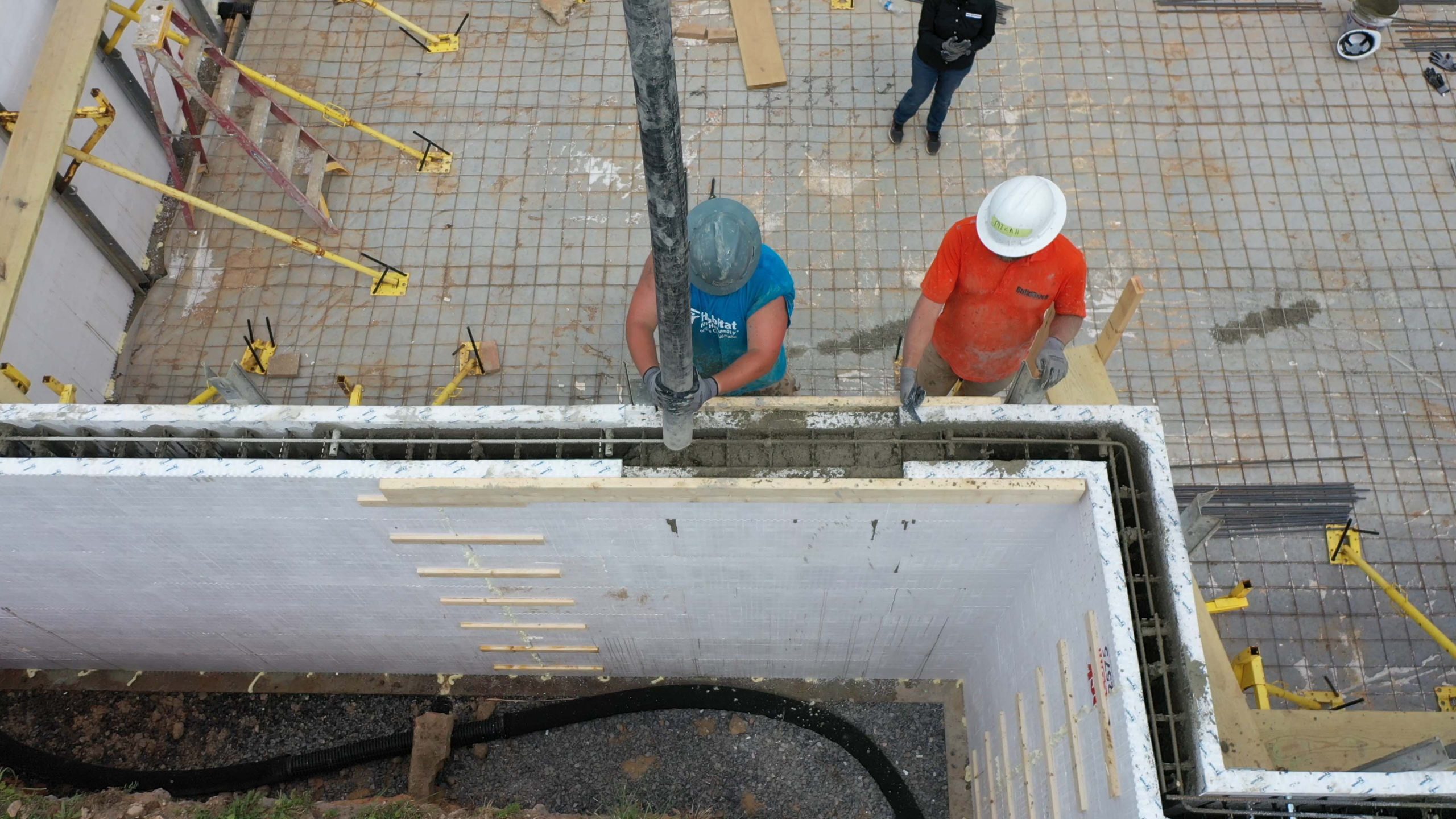
ICF basement wall pour.
Installer pouring concrete into an ICF wall.

Concrete should be placed via a boom pump, trailer pump, or hose system — not chute-dumped directly from the truck, which concentrates too much pressure in one location at once. Placement should proceed in lifts of no more than 4 feet at a time, working around the perimeter of the wall and returning to the starting point for another 4 feet of height, rather than filling one section completely before moving on. This distributes pressure evenly and prevents a single area from being over-stressed.  

Placing some concrete on other side of openings to balance the pressure is a good strategy to prevent shifting of openings during the pour. Do not pour concrete into a corner. The force of the concrete combined with the pressure from the pump could cause problems. Instead let the concrete drop straight down and build up until it flows naturally at about a 45-degree angle. When you get to a corner move to the other side and let it naturally flow into each side of the corner. 

Installer using a pencil vibrator to consolidate the concrete.

After each lift, use an internal vibrator (not touching the foam faces) to consolidate the concrete and eliminate entrained air, preventing voids, particularly around rebar and at corners. Use the fast in and slow out method. The goal is to mix the layers of concrete together and remove any entrained air ensuring a solid connection around reinforcement, and  around and below window and door openings.  

Internal vibration is the only approved method of concrete consolidation. It can be supplemented, but not replaced by external vibration. Keep a close eye on all wall sections during the pour — any bulge, shift, or crack in the foam from damage or over-vibrating will need immediate attention.  

As part of a pre-pour checklist, reviewing all bracing connections, checking rebar spacing and placement, and confirming all bucks are secured, is essential before the truck arrives. Ensuring you have tools, additional strapping and labor ready to assist with any problems will help create a safe and quality pour.

Step 8: Waterproofing the Exterior

Waterproofing is arguably the most critical step in insulated concrete form (ICF) basement construction, and it is where simple mistakes can cause costly long-term consequences. Building codes define two levels of moisture protection: damp-proofing (mostly applicable in crawlspaces), which protects against soil moisture but may not resist a column of liquid water, and full waterproofing, which provides complete protection against both moisture and liquid water. For habitable below-grade spaces, waterproofing is the preferred and often required standard, particularly in areas with high water tables or known soil-water conditions. 

Because ICF walls use EPS foam, waterproofing them is substantially different from standard concrete work. Solvent-based products such as hydrocarbons, chlorinated hydrocarbons, ketones, and esters must never be used, as they will dissolve the EPS foam. Only water-based or emulsion-based coatings are appropriate. 

BuildBlock recommends combining two complementary systems. The first is a self-adhesive peel-and-stick membrane such as Poly Wall Home Stretch Membrane. This 40-mil rubberized asphalt membrane is installed vertically with three inches of overlap at each seam, the bottom extending 1 to 3 inches out onto the footing and caulked, and the top mechanically terminated 8 to 12 inches above final grade using a termination bar attached to ICF web anchor points. A water-based primer applied to the EPS foam beforehand improves adhesion. 

ICF Walls and Waterproofing System

The second layer is an air gap or dimple membrane, such as DMX-AG or Platon. This plastic mat creates a uniform drainage plane between the wall and the surrounding earth. As hydrostatic pressure builds up, air is displaced and water is channeled downward rather than pressing against the wall surface. When installing both systems, the dimple membrane must not be screwed through the peel-and-stick layer below, as this would breach the primary waterproofing barrier. 

There are other liquid applied systems on the market that are approved for use with BuildBlock insulated concrete forms. Most of these require a contractor with specialty equipment to install, but they can offer a simpler install, high quality performance but at a premium price. As they are more greatly adopted, they will become more competitive. Everyone’s goal is a dry, comfortable basement. 

For additional protection in challenging environments, crystalline waterproofing additives such as Penetron, Xypex, or BASF Masterlife can be mixed directly into the concrete. These materials react chemically with the concrete’s hydrated compounds in the presence of water, growing insoluble crystals that seal capillaries and micro-cracks from within. They also increase concrete compressive strength and protect embedded rebar from moisture-induced corrosion.

Step 9: Foundation Drainage and Backfill

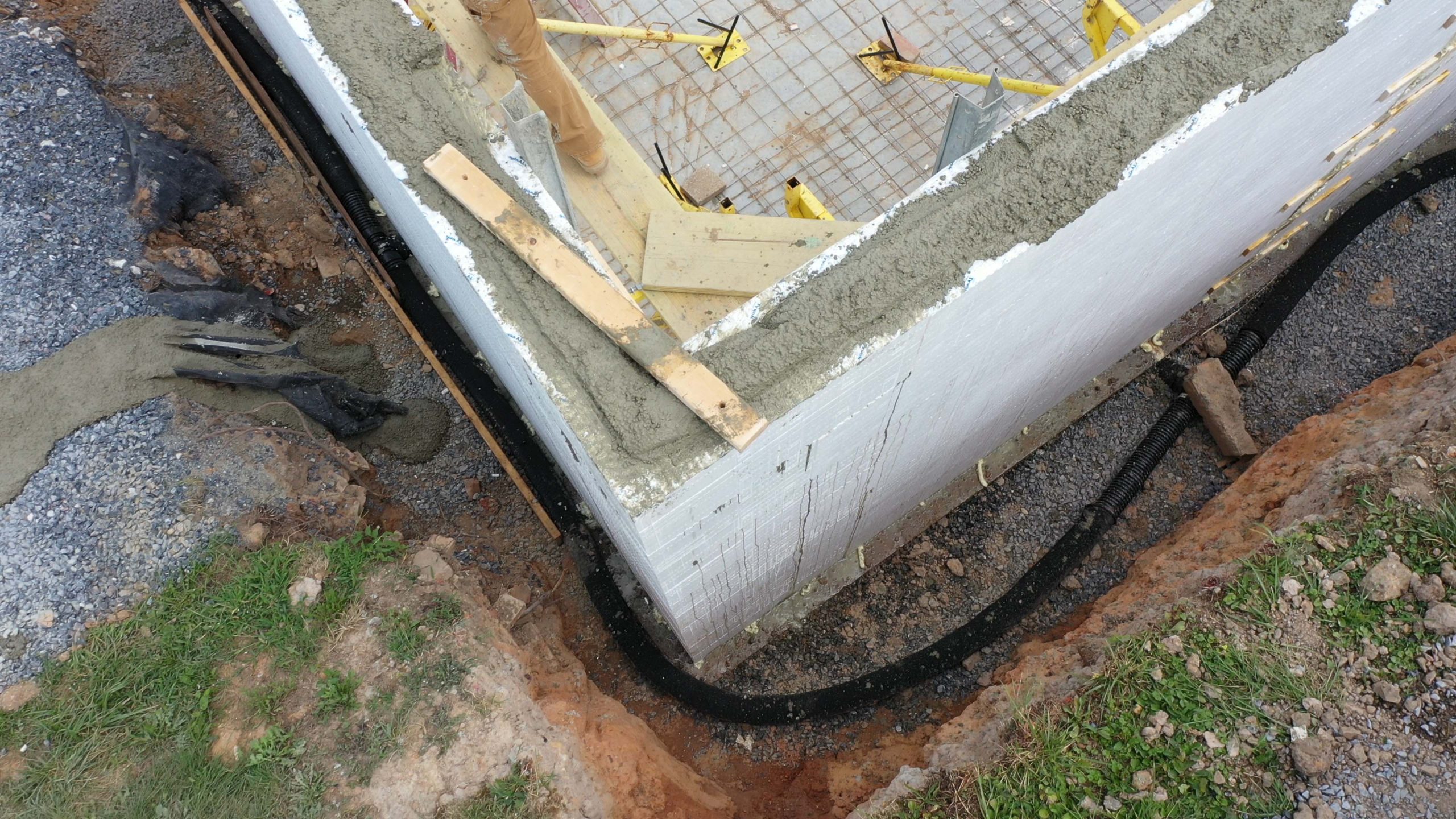
Once the walls are poured, cured, and waterproofed, the perimeter drainage system must be completed before backfilling. At the base of the wall, around the footing drain or if using Form-A-Drain, fine gravel should be placed to a minimum height of 12 inches. A layer of silt cloth is then placed on top of the gravel before additional soil fill is added above. 

Backfilling must be done carefully and in stages. Fill should be placed in lifts of approximately 2 feet, starting with gravel transitioning to soil, and compacted with a small machine rather than a heavy tractor. Large stones, sticks, or debris in the backfill material can puncture the waterproofing membrane. Critically, backfilling should never occur until the floor system above is in place to brace the tops of the basement walls against the inward pressure of the surrounding soil. Backfilling an unsupported insulated concrete form basement wall is one of the most common and serious mistakes in the process. The concrete core is strong, but lateral pressure from improperly placed fill against an unbraced top can crack or displace the wall. 

Once the final grade is established, soil should be sloped smoothly away from the building on all sides to ensure no standing water can migrate back toward the foundation walls. 

10. Finishing the Basement Interior

With the walls poured, the exterior protected, and once dried-in the interior of the insulated concrete form (ICF) basement is ready for mechanical rough-ins and finishing. Electrical wiring is typically run by using a hot knife, router, or chainsaw with a guard set to foam depth, to cut horizontal and vertical chases directly into the foam face, laying wire or conduit in if required in the channel, and securing with spray foam. Wire should be at least 2-inches behind the face of the foam (there is 2.5-inches of depth possible) or as required by local codes. 

Plumbing penetrations through the slab or wall should use sleeves installed before the pour. Drywall is attached directly to the ICF web ties located .5-inches below the foam surface and indicated by markings on the block using standard coarse thread screws — no additional furring or framing is required in most applications. If you cannot see the markings on a block, from any corner move out .75 inches and you will be in the center of a web. Do not overdrive the screws into the web ties to prevent cracking the plastic attachment point. Be especially careful if working in extremely cold weather. The foam surface provides the thermal break, so no additional interior insulation is needed in a properly designed insulated concrete form basement.

Summary

Building a basement with insulated concrete forms is a sequential, detail-driven process. The quality of every subsequent step depends on the precision of the one before it — a square excavation produces a square footing, a level first course produces a plumb wall, a properly braced wall survives the concrete pour, and a carefully waterproofed and backfilled exterior keeps the basement dry for the life of the structure. Done right, the result is a basement that is substantially stronger than a conventional poured concrete or masonry block foundation, better insulated than any above-grade wood-frame wall, and highly resistant to moisture, fire, and extreme weather events. 

icf basement poured and backfilled
Completed ICF basement for a large luxury home.

Building a basement foundation with insulated concrete forms (ICF) is one of the most durable, energy-efficient, and cost-effective approaches available. The resulting walls combine a reinforced concrete core with continuous expanded polystyrene (EPS) foam insulation on both sides — creating a structure that is stronger, quieter, and better insulated than a conventionally poured basement.

Review this video that walks you through a pre-pour inspection of an ICF basement.

Learn more alongside this guide at the BuildBlock Training Portal https://training.buildblock.com/ and with hands-on instruction from experienced insulated concrete form installers at training events.  

Let Us Help

Contact BuildBlock today and let our staff answer your questions and help make your project a success.